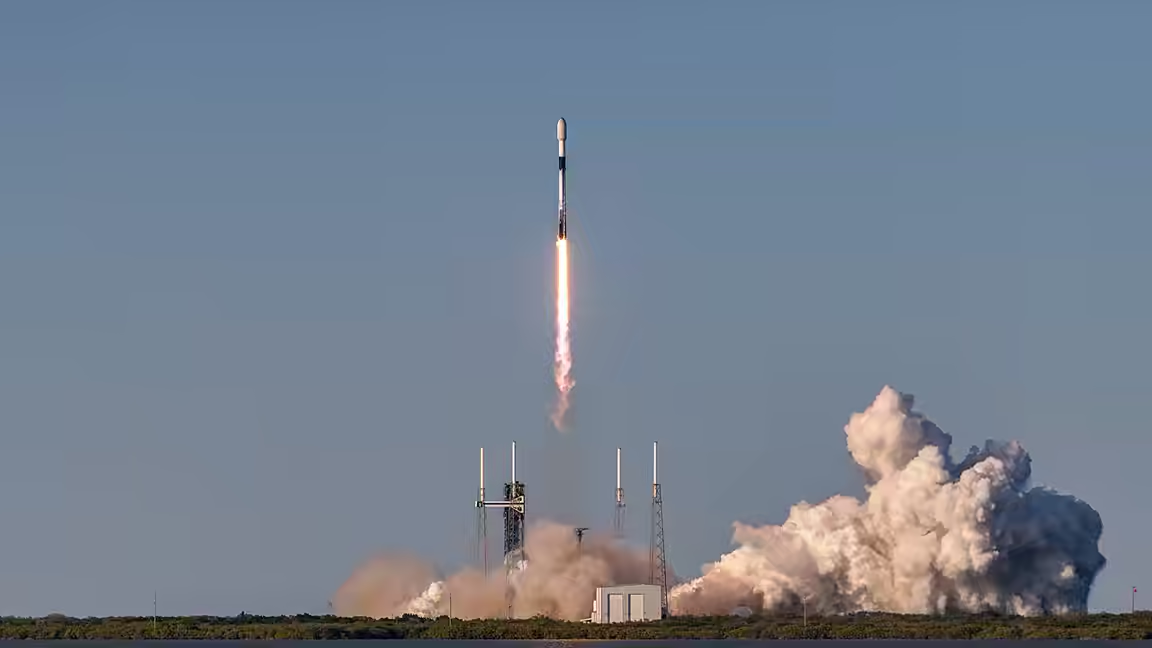
SpaceX reported a sharp increase in quarterly revenue and a return to profit for the three months ending in September, according to its second earnings disclosure since becoming a public company. The company said revenue was 161% higher than in the same period a year earlier, with growth tied largely to Starlink connectivity and its artificial-intelligence operations.
The company recorded an overall profit of $4.40 billion for the quarter. That reversed a $1.05 billion loss in the comparable period and followed another loss in the quarter ending in June. The latest figures therefore mark a change not only in sales momentum but also in SpaceX's ability to cover the costs of its expanding operations.
Connectivity remained central to the results. SpaceX said the segment that includes Starlink generated $5.2 billion in quarterly revenue, a 69% year-over-year increase. Starlink uses thousands of satellites to provide internet service, and the network has become the company's main profit engine alongside its launch and spacecraft businesses. The company recently acquired nationwide low-band spectrum, a move that could support broader competition with established US mobile carriers.
Artificial intelligence was another significant contributor, though it also illustrates the scale of SpaceX's investment. The company oversees xAI, which develops computing infrastructure and a chatbot that competes with services from OpenAI and Anthropic. AI spending more than doubled in the preceding quarter, when the unit posted a $1.26 billion operating loss. In the September quarter, the division reported $431 million in operating income.
The results followed SpaceX's first quarterly disclosure in August. For the June quarter, the company had reported $7.8 billion in revenue, up from $4 billion a year earlier, but costs exceeded revenue. The September report suggests that faster growth in connectivity and a swing in the AI unit's performance changed that balance.
Investors responded positively after the release. SpaceX shares rose nearly 4% in after-hours trading to about $153.30, while the company's market valuation approached $1.95 trillion. Those figures reflect investor expectations that recurring Starlink revenue and newer AI activities can complement the capital-intensive launch business.
The disclosure offers a clearer view of a company whose operations now span rockets, spacecraft, satellite broadband, spectrum and AI infrastructure. It also leaves important questions for future quarters, including whether the AI unit can sustain positive operating income and how quickly spectrum acquisitions can translate into new Starlink services. For now, the September quarter shows that SpaceX's rapid expansion produced both higher sales and an overall profit.