An experimental Linux desktop environment called DEsk has released an early public beta built around realistic skeuomorphic design. Instead of presenting a conventional flat workspace, the project renders a room in which windows appear as sheets of paper, applications sit in binders and notifications arrive through a post box.
The open-source project, previously called DeskWM, is now at version 0.1.2. Its developer describes the software as usable on the author's own machines but warns that this is a first release with rough edges and likely changes. The update includes fixes and an installer for Fedora, alongside installation options for several other major Linux distributions.
DEsk runs as a Wayland desktop rather than a visual theme placed over an existing environment. Its compositor draws the desk and room, including shared lighting and shadows, while established free-software programs handle common tasks such as web browsing, file management, text editing and terminal access. The project favours existing applications that can work under a wlroots-based compositor without being rewritten.
That division shapes the interface. Traditional GTK applications can be placed within DEsk's paper-like frames, while software that supplies its own header bar retains that frame inside a margin. A settings application controls the desktop's own behavior and links users to separate utilities for networking, sound, displays, printers, storage, accounts and other system functions.
The session also handles practical desktop duties. According to its documentation, DEsk starts compatible autostart services, manages screen blanking and locking, supports display-management protocols and provides controls for touchpads, pointers, keyboard layouts and repeat rates. It attempts to close applications cleanly during logout or shutdown so programs with unsaved work can interrupt the process.
Because its room effects can be demanding, DEsk offers graphics levels ranging from Ultra to a 2D fallback. The fallback removes shadows, blur, animation and ray tracing for computers without a capable graphics processor or for virtual machines using software rendering. An installation utility benchmarks basic system characteristics and suggests an initial graphics setting, which users can override.
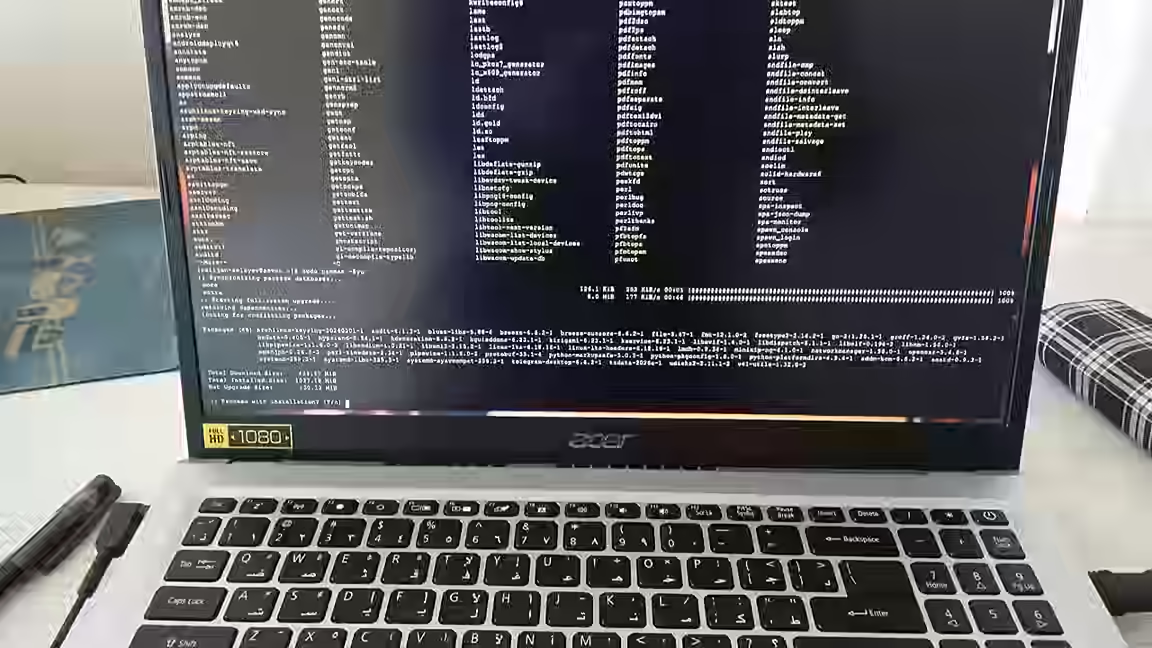
Installation scripts support package ecosystems used by Debian and Ubuntu, Fedora, Arch Linux and openSUSE. Users install the environment and then select DEsk from their login screen. The project remains beta software, so anyone testing it on a primary workstation should expect compatibility gaps and configuration changes.
DEsk's release is notable less for replacing the mature Linux desktops immediately than for testing a different visual model. It combines a deliberately physical metaphor with current Wayland infrastructure, while borrowing proven applications for most everyday work.