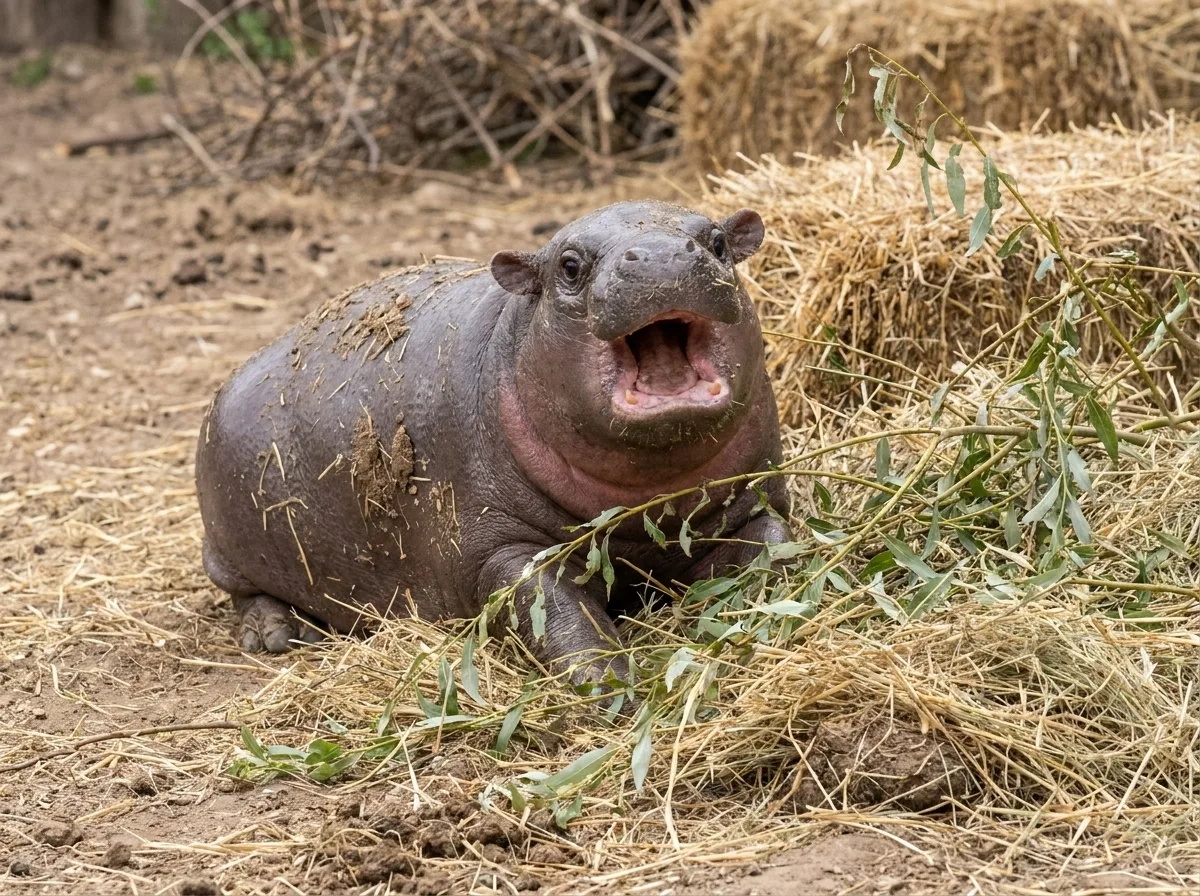
Southern France has an unexpected new celebrity, and she weighs only a fraction of what most people imagine when they hear the word hippopotamus. A newborn pygmy hippo named ELLA has become the center of an extraordinary wave of attention at a wildlife park near Avignon after the first photographs and videos of the calf began circulating online. The story is imagined at the Parc Animalier de La Barben, one of Provence’s best-known wildlife parks, located between Avignon and Marseille and home to hundreds of animals across dozens of species. Within only a few days of ELLA’s public introduction, what began as a routine zoo birth announcement transformed into a regional phenomenon, with families, tourists and animal enthusiasts traveling specifically to see the tiny hippo in person.
ELLA was born healthy after keepers spent weeks closely monitoring her mother and preparing a quieter section of the habitat for the arrival. During the first days, access was heavily limited so the mother and calf could remain largely undisturbed while veterinary teams monitored feeding, movement and early development. Pygmy hippos are dramatically smaller than common hippos and are known for their compact bodies, rounded faces and comparatively solitary behavior. Newborn calves are especially striking because their short legs, tiny ears and glossy skin give them an appearance that many online users describe as almost unreal. France already has several zoological parks participating in the conservation and management of pygmy hippos, an endangered species native to the forests and wetlands of West Africa.
The internet discovered ELLA almost immediately. One video posted by the park showed the calf slowly following her mother toward the water before stopping at the edge and staring into the pool for several seconds. After cautiously putting one foot forward, ELLA entered the shallow section, immediately changed her mind and backed out again. Another clip showed her attempting to chew a leaf significantly larger than her mouth before abandoning it and walking away. Neither moment was unusual from an animal-care perspective, but both proved almost perfectly designed for social media. Within hours, the videos were reposted across TikTok, Instagram and X, where users began calling ELLA “the baby hippo of Avignon.”
The most popular clip, however, showed almost nothing happening. ELLA simply stood beside her mother, turned toward the camera and stared directly into it for several seconds before slowly sitting down. The expression immediately became a reaction image. Users added captions about Monday mornings, work meetings, missed trains and realizing a vacation was ending. The combination of an unusually small hippo and a seemingly unimpressed facial expression transformed ELLA from a zoo newborn into an internet character almost overnight.
The online attention quickly became visible outside the screen. By the first weekend after her public debut, visitors were reportedly arriving long before the park opened. Lines formed near the entrance in the morning, and another queue developed around the viewing area once people entered. During the busiest periods, visitors were asked to keep moving after a limited viewing window so that more people could see the calf without creating excessive noise or pressure around the enclosure.
For some families, that meant waiting for more than two hours for an encounter that lasted only several minutes.
The uncertainty only made the experience more desirable. ELLA does not perform on command, and much of her day is spent sleeping, feeding or remaining in sections of the habitat where visitors cannot see her clearly. Someone can wait for an hour and discover that the famous baby hippo is asleep behind her mother. Minutes later, ELLA might suddenly walk toward the water, producing an immediate wave of phones rising above the crowd.
Videos of the queues have themselves started going viral. One clip shows a long line of visitors stretching through part of the park with the caption “Everyone is here for ELLA.” Another shows a family celebrating after finally seeing the calf following a nearly three-hour trip and a lengthy wait. The attention has surprised even regular zoo visitors, some of whom compare the atmosphere to waiting for a famous attraction rather than visiting an animal habitat.
Park staff in the story have repeatedly emphasized that ELLA’s welfare comes before the public attention surrounding her. Viewing hours can be reduced if the mother appears uncomfortable, and sections of the habitat may temporarily close when the animals need more privacy. Keepers are also asking visitors not to shout, bang on barriers or attempt to attract the calf’s attention, explaining that ELLA is still at an extremely early stage of development.
The popularity of ELLA follows a broader internet fascination with pygmy hippos. Their smaller size and distinctive proportions make calves particularly appealing in short videos, and individual animals at zoos around the world have repeatedly become viral celebrities. That visibility can create an unexpected conservation opportunity. Pygmy hippos are endangered, and their natural habitat in West Africa faces continuing pressure from deforestation, habitat fragmentation and human activity. A visitor who initially travels to see ELLA because of a funny TikTok video may leave knowing considerably more about the species than they did before.